BOOK REVIEW: The Wizard and the Prophet
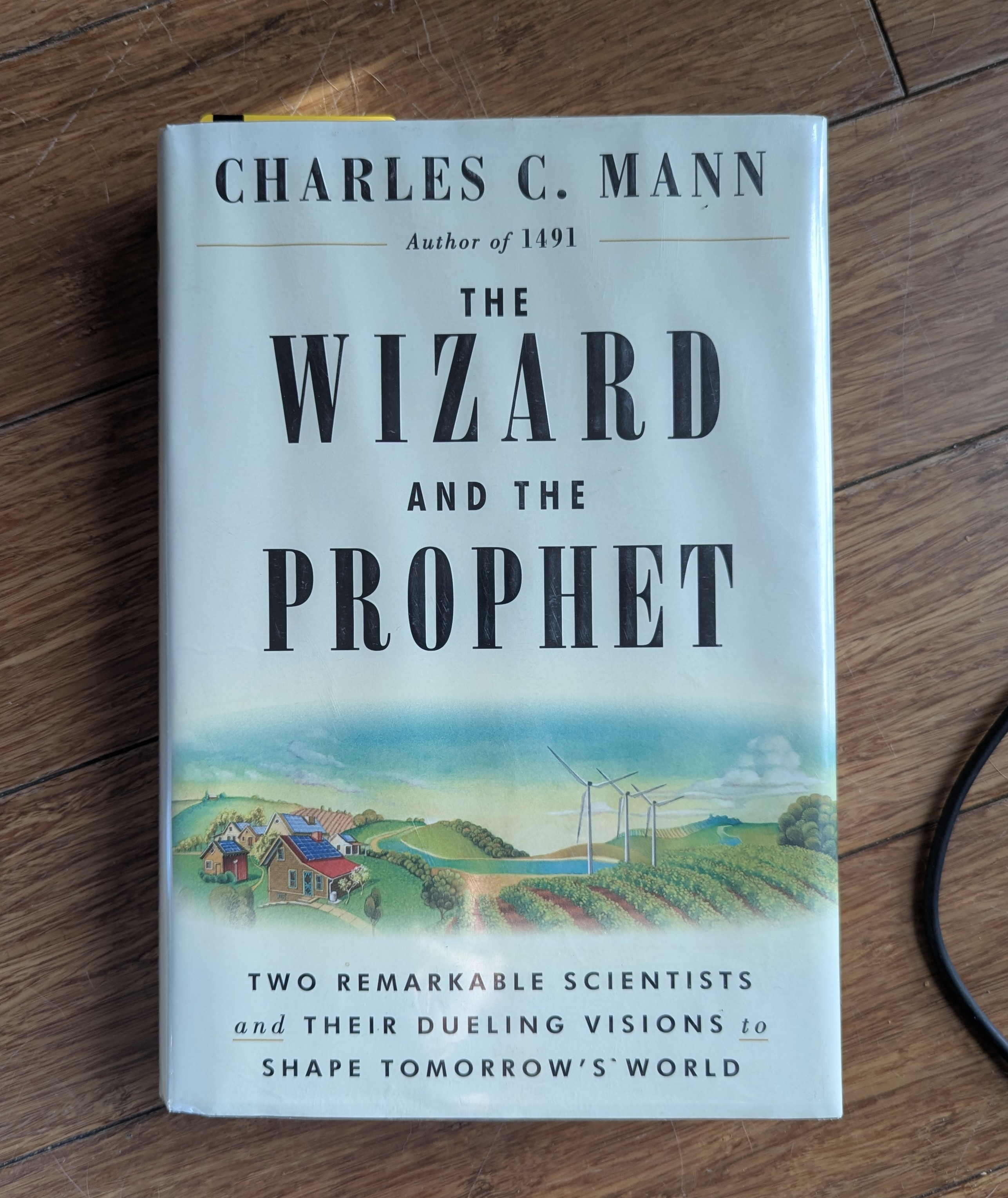
This book casts light on a heap of the background tensions that run through our profession. It’s structured around the idea that when we acknowledge planetary consequences of industrial society, we typically respond in one of two ways:
- Focusing on our proven capacity to innovate our way out of tight corners (wizards)
- Focusing on the importance of reducing human consumption to live within ecological limits (prophets)
Interestingly, journalist Charles C. Mann, author of The Wizard and the Prophet, characterises both these perspectives as grounded in an optimistic human exceptionalism, pointing out that to follow either of these doctrines is to accept a conscious responsibility for planetary consequences no species has accepted before us. (Doy, in my personal view).
The tracing of the wizardly ‘we can innovate our way out’ perspective is centred largely on the Green Revolution of the mid-20th century and one of it’s proponents, Nobel Peace Prize winner Norman Borlaug. Borlaug is credited, through his work on developing higher yield strains of wheat in Mexico in the 1960s, with saving roughly 1 billion people from starvation through the 20th century.
The prophet’s side of the story, that of the development of the conservation, organics, and environmental movements, is told largely through a tracing of the life of William Vogt, author of the 1948 best-seller Road to Survival, a book which Mann describes as
‘the first to portray our ecological worries as a single Earth-sized problem for which the human species is to blame.’86 and ‘the first to bring to a wide public a belief that would become a foundation of environmental thought: consumption driven by capitalism and rising human numbers is the ultimate cause of most of the world’s ecological problems, and only dramatic reductions in human fertility and economic activity will prevent a worldwide calamity’87
While you get the feeling that Mann himself comes down a little more on the side of the so called wizards here, the book is a model of good research in that it refrains from executing a beat-up on either side. The beat-up, of course, is always a juvenile impulse - and the general rule that the more you learn about something, the harder it becomes to caricature, applies here.
What Mann does an excellent job of through the book is, again and again, compellingly, reminding readers that these two perspectives are ideological, are visions of the good life, and that neither can be ruled in or out by some kind of a technocratic scientistic judegement. In the context of a profession and a broader progressive movement possessed of the guiding mantra that ‘the science tells us we have to act’, this book is a timely reminder that while this is unboundedly the case, the question of how to act is another kettle of fish entirely, one that can only be read out of data the same way fortunes are read out of cards or knucklebones.
One place that this argument is made compellingly is in Mann’s tracing of the impacts of agricultural reform through the 20th century on rapidly industrialising regional communities. Notes Mann:
“Beginning with the end of the Second World War, most national governments have intentionally directed labor away from the land … Farmwork was seen as “stagnant” and “unproductive.” The goal was to consolidate and mechanize farms, which would increase harvests and reduce costs’“214
The problem with this pivot, for those in the emerging organics and later environmental movement, was that:
‘many of its members were aristocratic Christians who saw industrial agriculture as a threat to both the social and divine orders.’179 and ‘didn’t want something as intimate as breakfast to be out of any possibility of control. To be so far removed from any identifiable human touch … all the scientific reports in the world wouldn’t address the sources of the foreboding. 206
The environmental movement’s coalescence in reaction against industrial society in general and industrial agriculture in particular is described in great detail through the book. Mann does a great service in highlighting the central role of population control, community scale sterilisation programs, and eugenics to the first decades of the movement, a connection I’d previously only seen noted in passing and certainly never in the context of my formal education in landscape architecture. In one of the heavier moments of the book, describing the formation of the global environmental movement in reaction against the early post-war global development work of UN affiliate organisations, Mann describes the movement’s early work as involving:
‘campaigns against pollution, awakening the world to threats of extinction, acquiring and setting aside huge tracts of land, and playing a prominent role in the sterilization of millions of women, under varying degrees of compulsion’ 375
The foundational sway of ideas of population control to the nascent environmental movement is rendered even more troubling when Mann quotes the opening lines to Dr. Paul R. Ehrlich’s infamously inaccurate (and Vogt inspired) 1968 book ‘The Population Bomb’. I reproduce the quote here in full:
‘I have understood the population explosion intellectually for a long time. I came to understand it emotionally one stinking hot night in Delhi a few years ago. My wife and I were returning to our hotel in an ancient taxi. The seats were hopping with fleas. The only functional gear was third. As we crawled through the city, we entered a crowded slum area. The temperature was well over 100, and the air was a haze of dust and smoke. The streets seemed alive with people. People eating, people washing, people sleeping. People visiting, arguing, and screaming. People thrusting their heads through the taxi window, begging. People defecating and urinating. People clinging to busses. People herding animals. People, people, people, people. As we moved slowly through the mob, hand horn squawking, the dust, noise, heat, and cooking fires gave the scene a hellish aspect.’
The trigger for this paranoiac rant? Over population, argued Ehrlich; humans outstripping their ecological bounds. But, as Mann soberly contextualises, Delhi’s population in 1968 was around 3 million. In the same year New York was home to nearly 8 million people, London 7 and a half million. Indeed, the larger citizenries of New York and London, one quickly recognises, would also have been consuming a far greater per person fraction to the planet’s resources at this time. Yet it’s poor people in Delhi who are singled out by Ehrlich to be scapegoated with dehumanising epithets like ‘stinking’, ‘thrusting’, ‘mob’, and ‘hellish’.
Why? Because the (again, inaccurate) alarmist prognostication of a ‘carrying capacity’ crisis, of population overload and collapse, was never a question of raw data and inescapable constraints. Rather it was always a handy rhetorical device for wrapping a particular vision of a particular good-life in the ever-alluring aesthetic of incontrovertible science.
…
But there I go again, after praising the book for not taking sides I’m sliding into the angry rant myself. I guess it’s because I’m frustrated by the extent to which the environmental movement gets a free pass in our discourse while the inherent evil of industrial society is more often than not rendered as a truth universally acknowledged.
This book is a breath of fresh air for me in that it does not dismiss out of hand the reality that the Green Revolution (industrial agriculture, shuttle breeding, and factory fertilizer) has saved roughly a billion people from slow dehumanising death by starvation. I acknowledge it’s up to each of us individually to decide whether we want to look at this billion as a billion mouths or as a billion souls - but either way it feels to me like something that should figure.
After I finished The Wizard and the Prophet I started reading Dominion, Tom Holand’s pop history of the influence of Christianity on contemporary western culture. In the introduction he says ‘It is the incomplete revolutions which are remembered; the fate of those which triumph is to be taken for granted.’
Evidently.